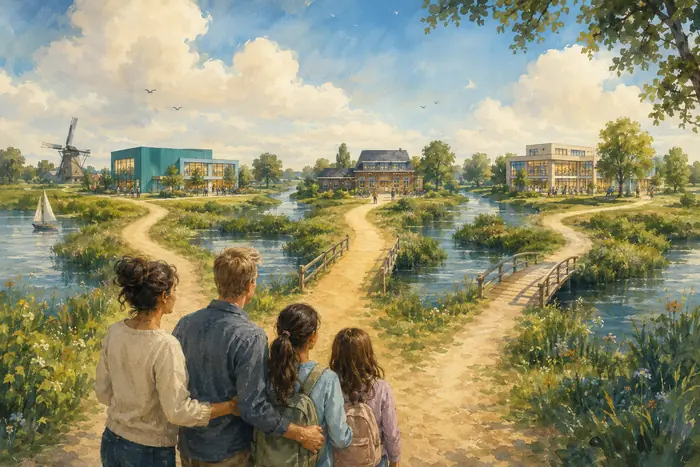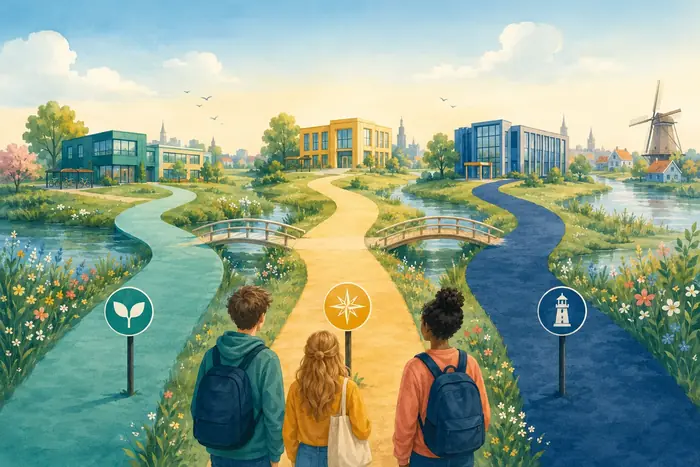
Moving to a new country is already a big transition. Then your child starts school, and suddenly you hear new words everywhere: basisschool, groep 8, schooladvies, Doorstroomtoets, VMBO, HAVO, VWO. For parents who did not grow up in the Dutch education system, it can feel confusing. The good news is that once you understand the basics, the system becomes much easier to follow.
The Dutch education journey at a glance
Most children follow: early childhood education → primary school (basisschool) → secondary school (middelbare school) → further education or vocational training. Children usually start primary school around age 4 and finish around age 12. The final year of primary school is called Groep 8 — the year children prepare for the transition to secondary education.
Primary school in the Netherlands
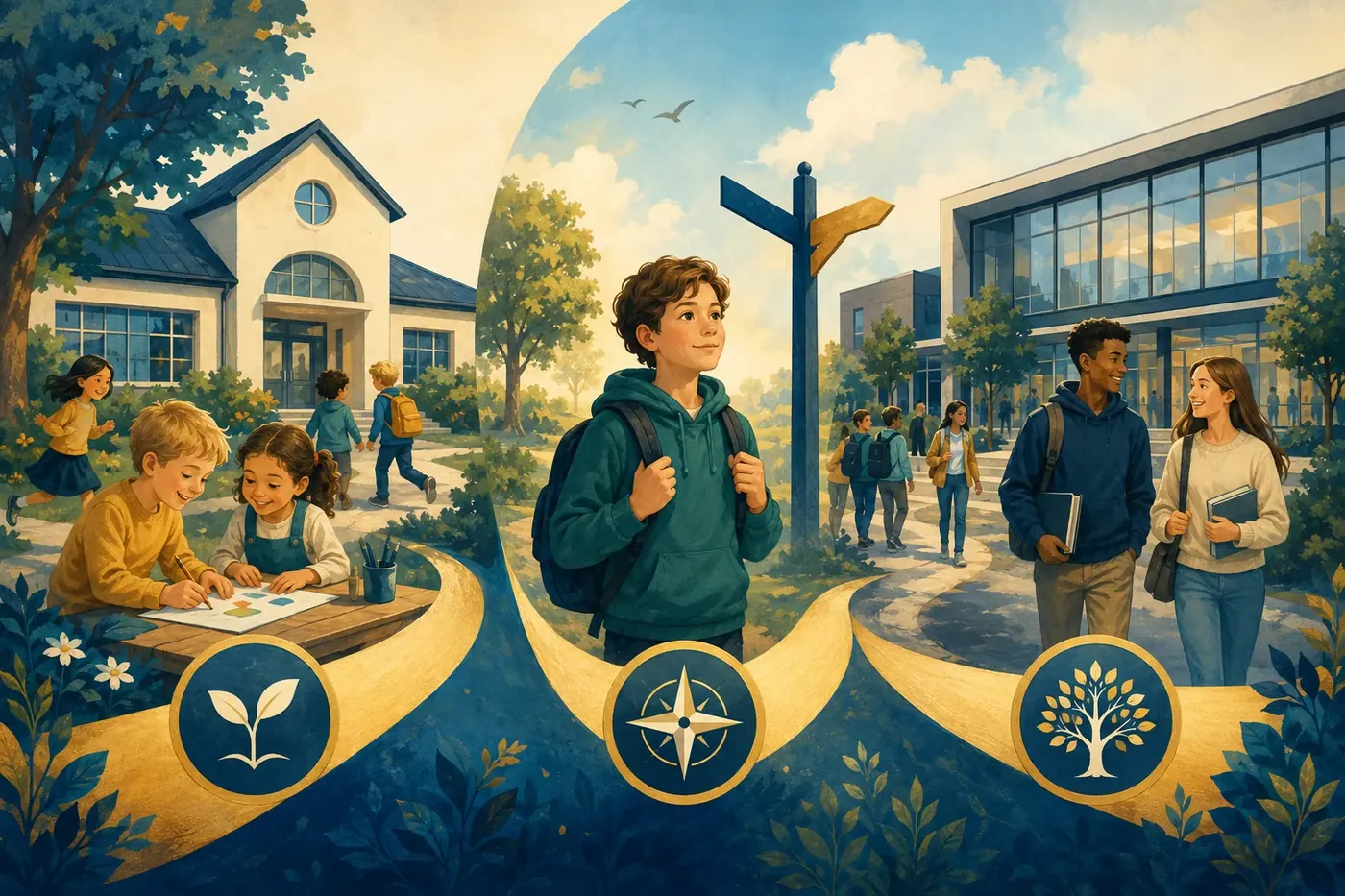
Dutch primary schools usually have eight groups: groep 1–2 (early years/kindergarten) and groep 3–8 (primary education). During these years, children develop skills in reading, writing, mathematics, language, world orientation (including geography and history), and social development. Unlike some countries where children specialise early, Dutch primary education focuses on building a broad foundation.
Why is Group 8 such an important year?
Group 8 is the final year of primary school — a year of transition. Children are preparing for a new school environment, more independence, new responsibilities, and different subjects and teachers. During this year, schools start discussing the next educational pathway, which is often where international parents hear new terms for the first time.
Understanding school advice (Schooladvies)
In the Netherlands, children do not apply to secondary school based only on one exam. Instead, the primary school provides advice — the schooladvies — about the type of secondary education that best matches the child. This is based on academic development over several years, mathematics skills, reading comprehension, learning behaviour, independence, and motivation. Teachers know the child well because they've followed their development over time.
What is the Doorstroomtoets?
The Doorstroomtoets is a national assessment taken in Group 8, focusing mainly on language, reading comprehension, and mathematics. It is not meant to define a child — it's one piece of information that helps create the best possible advice. A child's personality, motivation, development, and wellbeing matter just as much.
What happens after the Doorstroomtoets?
After the results are available, the school reviews the advice. If the result suggests a higher level may suit the child, the school considers whether the advice should be adjusted. The final advice is then used when choosing a secondary school.
Secondary education in the Netherlands
- VMBO — a practical and vocational pathway; many students continue into MBO education.
- HAVO — prepares students for higher professional education (HBO).
- VWO — the most academically oriented pathway, preparing for university.
- Mixed pathways, such as VMBO/HAVO or HAVO/VWO, give children flexibility and recognise that development continues during secondary school.
A common misunderstanding: "Higher is always better"
Many international parents initially think the highest level must be the goal. But the Dutch system is built around a different idea: the best pathway is the one where a child can learn, grow, and succeed. A child who feels confident and motivated often develops further than a child constantly struggling under pressure. Success looks different for every child.
How can international parents support their child?
- 1Ask questions. Don't worry if the system feels unfamiliar. Ask teachers how your child is developing, their strengths, what needs attention, and how you can support learning at home. Dutch schools are used to working with families from different backgrounds.
- 2Learn the vocabulary. Basisschool (primary school), Groep 8 (final year of primary school), Schooladvies (secondary school recommendation), Doorstroomtoets (assessment taken in Group 8), Middelbare school (secondary school), HAVO/VWO/VMBO (different secondary pathways).
- 3Support confidence. The transition to secondary school is emotional. Children are not only changing schools — they are growing into a new stage of life. The most important message: "you are capable, you can learn, we believe in you."
Why In Galop believes learning should feel positive
When children prepare for important moments like Group 8 and the Doorstroomtoets, it's easy for learning to become focused only on results. But children need more than practice — they need curiosity, confidence, moments where they experience "I can do this." That is the idea behind In Galop: a learning adventure where children can practise important skills while exploring, building, and creating their own world. Because the journey matters as much as the destination.
The Dutch education system may seem complicated at first — new words, new traditions, new expectations. But you do not need to understand everything immediately. Your child doesn't need a perfect guide through the system. They need someone who believes in them, who encourages them, who reminds them that learning is a journey.
Verhuizen naar een nieuw land is al een grote overgang. Dan begint je kind aan school, en ineens hoor je overal nieuwe woorden: basisschool, groep 8, schooladvies, Doorstroomtoets, VMBO, HAVO, VWO. Voor ouders die niet zijn opgegroeid in het Nederlandse onderwijssysteem kan dat verwarrend voelen. Deze gids legt de Nederlandse onderwijsreis uit, van basisschool tot middelbare school.
De Nederlandse onderwijsreis in vogelvlucht
De meeste kinderen in Nederland volgen dit pad: voorschoolse educatie → basisschool → middelbare school → vervolgonderwijs of beroepsopleiding. Kinderen starten meestal rond hun vierde jaar op de basisschool en ronden deze af rond hun twaalfde. Het laatste jaar van de basisschool heet groep 8 — het jaar waarin kinderen zich voorbereiden op de overgang naar het voortgezet onderwijs.
Basisschool in Nederland
Nederlandse basisscholen hebben meestal acht groepen: groep 1-2 (kleuters) en groep 3-8 (basisonderwijs). In deze jaren ontwikkelen kinderen vaardigheden op het gebied van lezen, schrijven, rekenen, taal, wereldoriëntatie (waaronder aardrijkskunde en geschiedenis) en sociale ontwikkeling. In tegenstelling tot sommige landen waar kinderen vroeg specialiseren, richt het Nederlandse basisonderwijs zich op het opbouwen van een brede basis.
Waarom is groep 8 zo'n belangrijk jaar?
Groep 8 is het laatste jaar van de basisschool — een overgangsjaar. Kinderen bereiden zich voor op een nieuwe schoolomgeving, meer zelfstandigheid, nieuwe verantwoordelijkheden en andere vakken en leerkrachten. In dit jaar beginnen scholen het gesprek over het volgende onderwijstraject — het moment waarop internationale ouders vaak voor het eerst nieuwe termen horen.
Schooladvies begrijpen
In Nederland melden kinderen zich niet aan voor het voortgezet onderwijs op basis van slechts één examen. In plaats daarvan geeft de basisschool advies over het type vervolgonderwijs dat het beste bij het kind past — het schooladvies. Dit advies is gebaseerd op een combinatie van factoren: academische ontwikkeling over meerdere jaren, rekenvaardigheden, begrijpend lezen, leergedrag, zelfstandigheid en motivatie. Leerkrachten kennen het kind goed omdat ze de ontwikkeling over tijd hebben gevolgd.
Wat is de Doorstroomtoets?
De Doorstroomtoets is een landelijke toets die in groep 8 wordt afgenomen. Hij helpt om extra informatie te geven over de vaardigheden van een kind, met de focus op taal, begrijpend lezen en rekenen. De toets is niet bedoeld om een kind te definiëren — het is één onderdeel van de informatie die helpt bij het beste mogelijke advies. Persoonlijkheid, motivatie, ontwikkeling en welzijn zijn net zo belangrijk.
Wat gebeurt er na de Doorstroomtoets?
Na de resultaten bekijkt de school het advies opnieuw. Als het resultaat aangeeft dat een hoger niveau bij het kind zou kunnen passen, overweegt de school of het advies moet worden aangepast. Het definitieve advies wordt vervolgens gebruikt bij het kiezen van een middelbare school.
Voortgezet onderwijs in Nederland
Na de basisschool stromen leerlingen meestal door naar een van de volgende trajecten:
- VMBO — een praktisch en beroepsgericht traject; leidt vaak door naar het mbo.
- HAVO — bereidt voor op hoger beroepsonderwijs (hbo).
- VWO — het meest academisch gerichte traject, bereidt voor op de universiteit.
- Gemengde trajecten, zoals VMBO/HAVO of HAVO/VWO, geven flexibiliteit en erkennen dat ontwikkeling doorgaat tijdens het voortgezet onderwijs.
Een veelvoorkomend misverstand: "hoger is altijd beter"
Veel internationale ouders denken aanvankelijk dat het hoogste niveau het doel moet zijn. Maar het Nederlandse systeem is gebouwd rond een ander idee: het beste onderwijstraject is het traject waarop een kind kan leren, groeien en slagen. Een kind dat zich zelfverzekerd en gemotiveerd voelt, ontwikkelt zich vaak verder dan een kind dat voortdurend onder druk worstelt. Succes ziet er voor ieder kind anders uit.
Hoe kunnen internationale ouders hun kind ondersteunen?
- 1Stel vragen. Maak je geen zorgen als het systeem onbekend aanvoelt. Vraag de leerkracht: hoe ontwikkelt mijn kind zich, wat zijn de sterke punten, welke gebieden hebben aandacht nodig, hoe kunnen we thuis ondersteunen? Nederlandse scholen zijn gewend om met gezinnen van verschillende achtergronden te werken.
- 2Leer de woordenschat. Basisschool (primary school), groep 8 (laatste jaar basisschool), schooladvies (advies voortgezet onderwijs), Doorstroomtoets (toets in groep 8), middelbare school (secondary school), HAVO/VWO/VMBO (verschillende onderwijstrajecten).
- 3Ondersteun vertrouwen. De overgang naar de middelbare school is emotioneel. Kinderen veranderen niet alleen van school — ze groeien naar een nieuwe levensfase. De belangrijkste boodschap die ze nodig hebben: "je kunt dit, je kunt leren, we geloven in je."
Waarom In Galop gelooft dat leren positief moet aanvoelen
Wanneer kinderen zich voorbereiden op belangrijke momenten zoals groep 8 en de Doorstroomtoets, wordt leren gemakkelijk alleen gericht op resultaten. Maar kinderen hebben meer nodig dan alleen oefening — ze hebben nieuwsgierigheid nodig, vertrouwen, momenten waarop ze ervaren "ik kan dit." Dat is het idee achter In Galop: een leeravontuur waarin kinderen belangrijke vaardigheden oefenen terwijl ze ontdekken, bouwen en hun eigen wereld creëren. Want de reis is net zo belangrijk als de bestemming.
Het Nederlandse onderwijssysteem lijkt in het begin misschien ingewikkeld — nieuwe woorden, nieuwe tradities, nieuwe verwachtingen. Maar je hoeft niet meteen alles te begrijpen. Je kind heeft geen perfecte gids door het systeem nodig. Het heeft iemand nodig die erin gelooft, die aanmoedigt, die eraan herinnert dat leren een reis is.